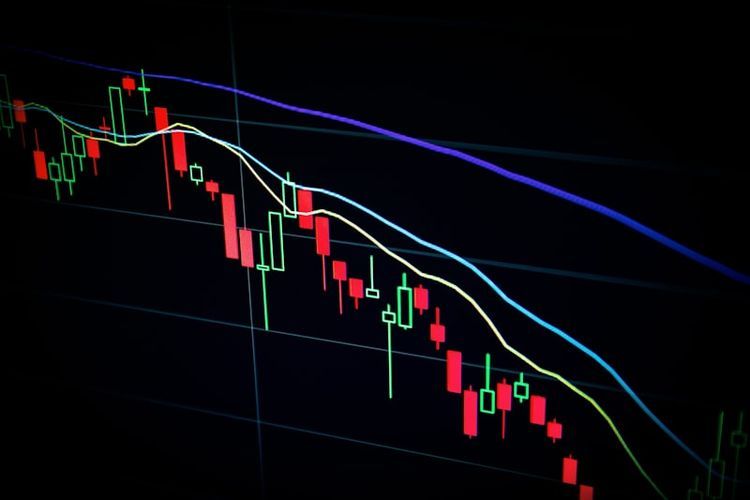
Bollinger Bands is a trend-following indicator invented by John Bollinger that uses statistical price volatility ranges to assess market conditions. In crypto trading, Bollinger Bands help identify overbought/oversold zones, anticipate breakout directions, and evaluate volatility. It's one of the most widely used technical indicators alongside moving averages and MACD.
What Are the Three Lines of Bollinger Bands?
Bollinger Bands consist of three lines:
Middle Band: Typically the 20-day Simple Moving Average (SMA20), representing the medium-term trend direction.
Upper Band: Middle Band + 2 standard deviations. Represents the upper volatility boundary.
Lower Band: Middle Band - 2 standard deviations. Represents the lower volatility boundary.
Statistically, approximately 95% of price data falls between the upper and lower bands under normal conditions. When price touches either band, the market is at a relatively extreme position.
What Does Band Width Indicate?
Band width (distance between upper and lower bands) reflects market volatility:
Narrowing Bands (Squeeze):
- Upper and lower bands converge
- Market volatility decreases, price enters consolidation
- Usually signals a major move is approaching
- The longer the squeeze, the bigger the subsequent breakout
Expanding Bands (Expansion):
- Upper and lower bands diverge
- Market volatility increases, a trending move begins
- Price rides along the upper or lower band
- Expansion direction hints at trend direction
Key Signal: When bands squeeze to an extreme and then suddenly expand, it often presents the best trading opportunity.
What Does Price Touching the Bands Mean?
Touching the Upper Band:
- In ranging markets: May indicate short-term overbought conditions with pullback risk
- In uptrends: Price riding the upper band is a sign of strength — don't blindly short
Touching the Lower Band:
- In ranging markets: May indicate short-term oversold conditions with bounce potential
- In downtrends: Price riding the lower band is a sign of weakness — don't blindly buy the dip
Breaking Through Bands:
- Price briefly breaks above the upper band then pulls back → strong resistance signal
- Price briefly breaks below the lower band then bounces → strong support signal
- Sustained movement outside the upper band → extreme bullishness (rare)
How to Apply Bollinger Bands in Trading
Strategy 1: Range Trading
- Works when bands are flat and price oscillates between them
- Consider buying near the lower band
- Consider selling near the upper band
- Use the middle band as a reference for take-profit or stop-loss
Strategy 2: Breakout Trading
- Watch for breakout direction after prolonged squeeze
- Price breaks above upper band with increased volume → long signal
- Price breaks below lower band with increased volume → avoid or cut losses
Strategy 3: Trend Following
- In strong uptrends, price rides the upper band; the middle band serves as pullback support
- In strong downtrends, price rides the lower band; the middle band serves as bounce resistance
- Price pulling back to the middle band is an add-on opportunity (in uptrends)
Are Bollinger Bands Better Combined with Other Indicators?
Bollinger Bands work best when combined with:
Bollinger Bands + RSI:
- Price at lower band + RSI in oversold zone (< 30) → strong buy signal
- Price at upper band + RSI in overbought zone (> 70) → strong sell signal
Bollinger Bands + MACD:
- Band squeeze + MACD golden cross → higher probability of upward breakout
- Band squeeze + MACD death cross → higher probability of downward breakout
Bollinger Bands + Volume:
- Breakout with volume surge → likely genuine breakout
- Breakout with low volume → likely false breakout
To practice Bollinger Band analysis in real markets, first register on Binance — the exchange charting tools include Bollinger Bands. You can also download the Binance app — iPhone users can refer to the iOS installation guide.
Safety Reminders
When trading with Bollinger Bands, keep these points in mind:
- Don't mechanically buy at the lower band and sell at the upper band: In trends, price can ride one band continuously
- Distinguish between ranging and trending markets: Bollinger Band strategies differ completely in each
- Confirm with volume: Any Bollinger Band signal needs volume confirmation
- Set stop-losses: When buying at the lower band, set your stop-loss below it
- Don't overtrade: Not every band touch is a trading opportunity — wait for high-probability signals
- Watch for extremes: During market panic or euphoria, price can remain outside the bands for extended periods
Should I Change the Default Parameters?
The default (20, 2) works for most situations. For short-term trading, try (10, 1.5); for long-term, try (50, 2.5). Any parameter changes should be backtested — beginners should stick with defaults.
Which Timeframe Works Best?
Bollinger Bands perform best on 4-hour and daily charts. 1-minute and 5-minute charts produce too much noise for beginners. Weekly charts are good for identifying major trends.
Can Band Expansion Direction Predict Price Movement?
Band expansion only indicates increasing volatility — it cannot directly predict direction. You need to combine it with the direction of the price breakout. Price breaking above the upper band with expansion suggests an uptrend; the reverse suggests a downtrend.
Why Are Bollinger Band Signals Sometimes Inaccurate?
Bollinger Band signals can fail during strong trends. For example, in a sustained uptrend, price may repeatedly touch the upper band without pulling back. Shorting based on the upper band touch would result in continuous losses. The key is first determining whether the market is ranging or trending.